Tom came to Episode 102 with a fun fact and a disclaimer.
"Sports lore credits the 1894 football team from Gallaudet with inventing the huddle," he said, "so that no opponents could read their signals." Then the hedge: "I don't know if that's fact or not, but that sounds like it could be true."
It's true. Mostly. And it's a better story than the version that fits on a trivia card.
Juniata hosts Gallaudet on Tuesday at 4 p.m., the last game before the turkey. So we went looking at where the huddle came from, who else claims it, and what it says about the team walking into The Nest.
Fall 1894
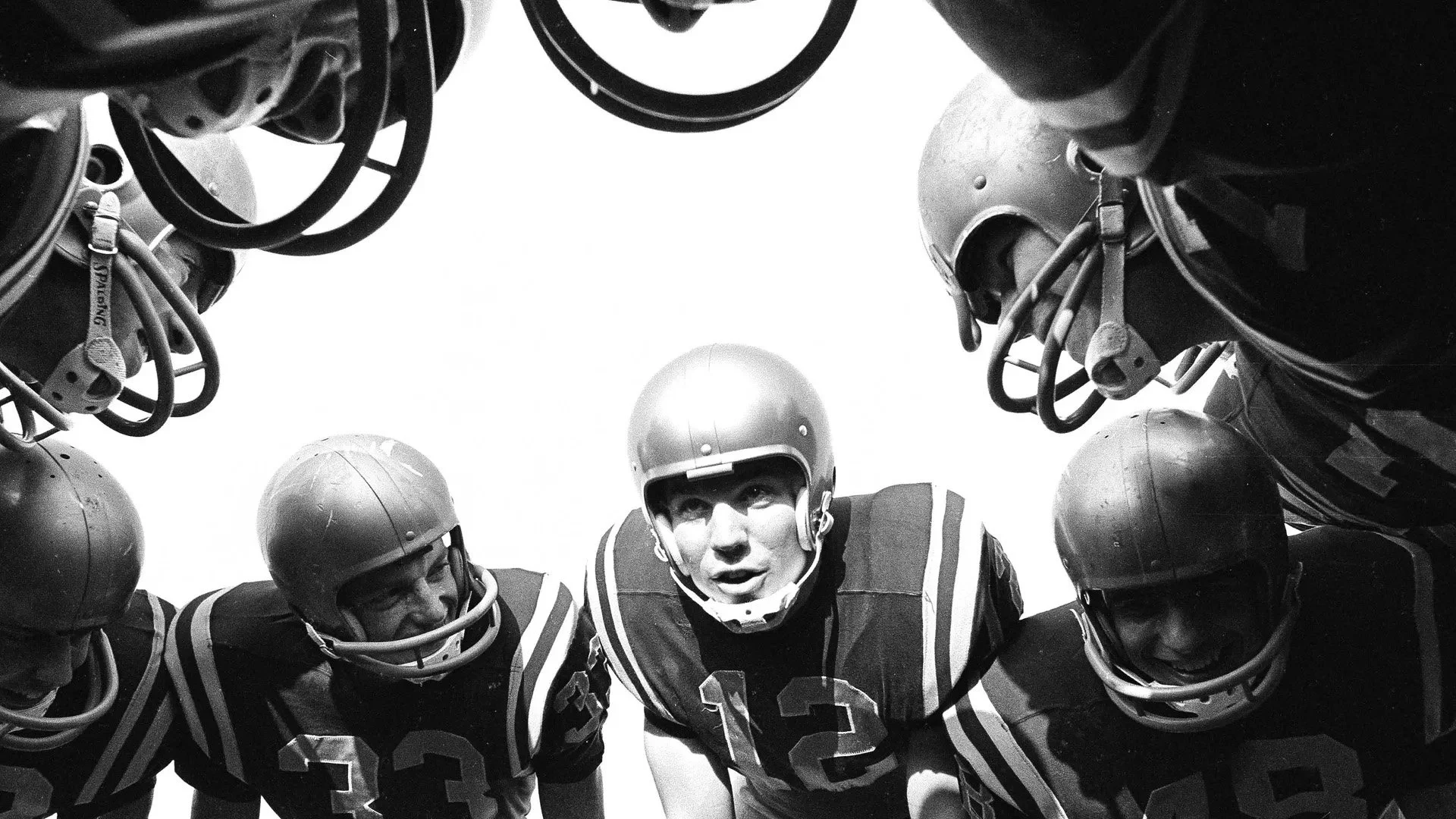
Paul Hubbard was Gallaudet's quarterback from 1892 to 1895. Gallaudet is in Washington, D.C., and it is built for deaf and hard-of-hearing students, so the Bison called plays the obvious way: in sign language, at the line.
The problem was that the deaf schools they played could read sign language too. According to Smithsonian magazine and Gallaudet's own athletics history, opponents were picking off Gallaudet's plays because the signs were out in the open. Hubbard's fix was simple. He pulled his teammates into a tight circle, backs to the defense, and signed the play inside it.
Gallaudet went 5-2-1 that season. Its wins included a 24-0 shutout of the Pennsylvania Deaf School and a 20-6 win over the New York Deaf School.
The kid nicknamed "the Eel" had just changed every sport with a sideline.
The man after the huddle
Hubbard graduated and moved to Olathe, Kansas, to teach at the Kansas School for the Deaf. He started its football program in 1899, brought the huddle with him, coached for years, then became the school's first athletic director. He retired in 1942 after 43 years and died in 1946.
By then, Gallaudet's student newspaper, the Buff and Blue, had already named him the "daddy of huddle." That was 1941.
Who else claims it
Here's the honest part. The huddle has more than one father.
Pitt, 1924. Herb McCracken said he invented the huddle as Pittsburgh's coach. Smithsonian notes the claim.
Illinois. Some histories credit Illinois coach Bob Zuppke. Gallaudet's athletics department says Zuppke admitted he got the idea from "a deaf team he saw somewhere." That quote comes from Gallaudet, not an independent source.
Oregon State, around 1918. Coach Bill Hargiss had his offense stand back from the ball and whisper plays, according to Wikipedia's history of the huddle, which dates the story to 1918.
What nobody seems to dispute is the date. Gallaudet's circle came decades before anyone else's. By the 1920s, Smithsonian reports, the huddle was common enough in college football that fans complained it slowed the game down. From there it jumped to basketball, baseball and everything else.
So the claim on Gallaudet's website, "Home of the Huddle," holds up. Not because nobody else ever thought of it. Because they thought of it first, for the best reason anyone ever had.
The huddle never left
Gallaudet still plays like it invented this stuff, because it did.
The football team now plays in the Old Dominion Athletic Conference. Per Cardinal News and D3football.com, the Bison run a silent snap count. A bass drum on the sideline signals special teams, because players can feel it. Plays get signed in from the sideline. In 2023 they tried a 5G helmet to send plays to the quarterback. In 2025, coach Stefan LeFors went back to signing. The tech was slow. The hands were faster.
Basketball works the same way. When NPR profiled Gallaudet women's basketball in 2024, coach Stephanie Stevens explained that she doesn't yell. She waves her arms or stomps her feet, and her players feel it through the floor and look to the bench. Associate athletic director Sam Atkinson said Bison fans can be louder than anyone because "they don't know how loud they are."
The men's coach, Sekoe White, is one of their own. He scored 1,166 points for Gallaudet, captained the team for three seasons and graduated in 2010. He has coached at three schools for the deaf and on USA Deaf Basketball's staff, and Gallaudet hired him in September 2025.
What Coach Curley sees
Coach Greg Curley didn't spend his Gallaudet preview on sign language. He spent it on toughness.
"These are tough kids by nature," he said. "They've had to just go through more challenges in life than most. And they have that in common. So immediately, the bond of those guys playing for each other is something significant."
That's the huddle, really. Not a formation. A decision. Eleven guys, or five, turning their backs to everyone else so they can trust each other with what comes next.
It's also exactly what Curley was asking of his own team this week. After the Susquehanna loss, he said Juniata went away from itself: too much one-on-one, not enough moving the ball, lost poise. After Drew, he talked about the bench, where "every guy was genuinely into it," and about "the power of a team."
Tuesday, Juniata plays the team that put the huddle on the map. Coach's scouting report: a lot of zone, explosive guards, great in transition, physical, and a group that plays super hard because things have always been hard. "It's a really neat opportunity," he said, "and it's a good example and opportunity for our guys."
Tom predicts 100 points. Coach would settle for a win and an extra piece of turkey.
Hear the full conversation on Episode 102 of The Juniata Men's Basketball Show with Tom Frank, Drew "Biz" Besket and Coach Greg Curley. Juniata hosts Gallaudet on Tuesday, Nov. 24, at 4 p.m. at The Nest.