Fifty Years of Practice, Zero Improvement. Then the Line Moved.
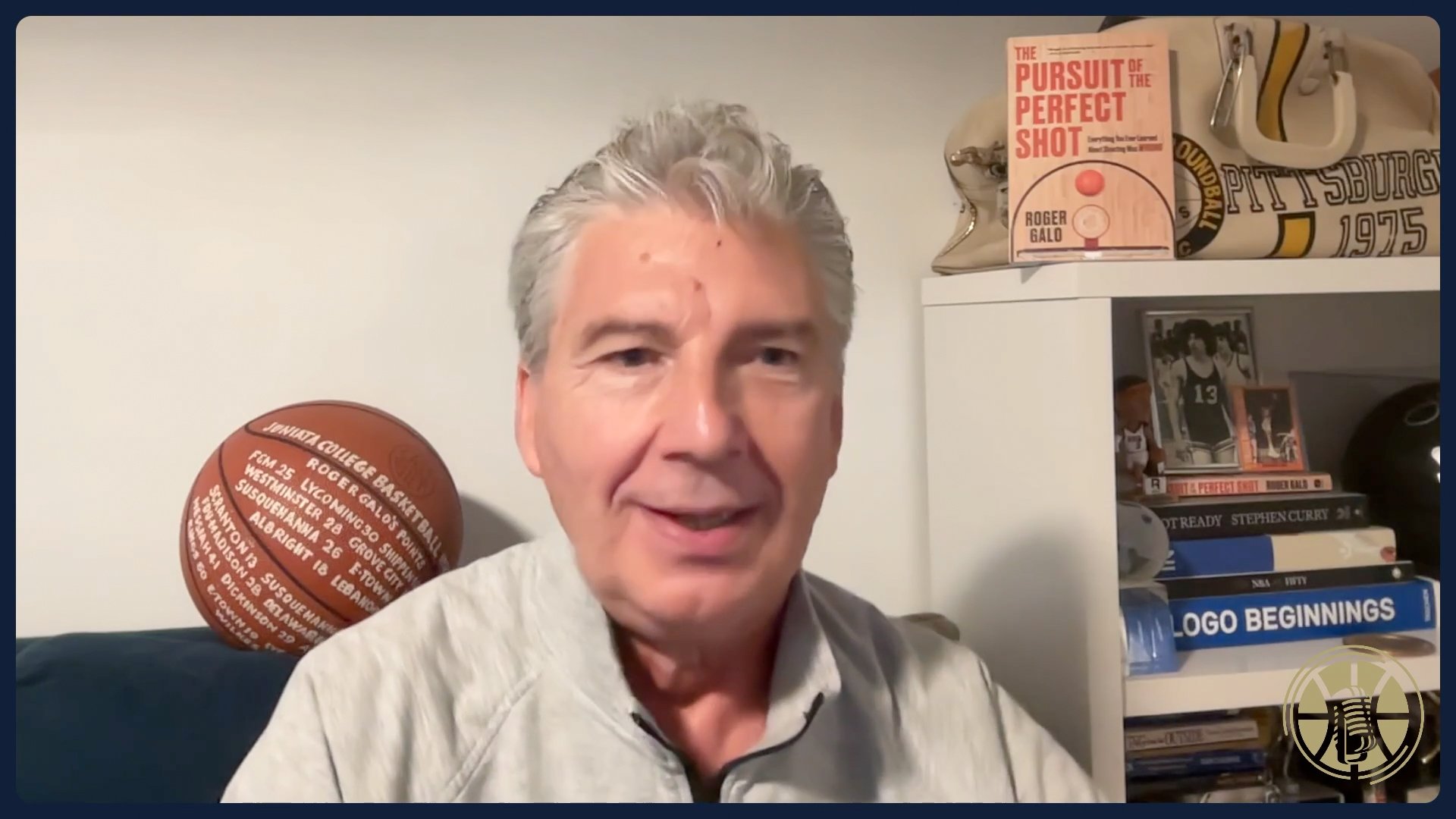
Roger Galo scored 50 points in a game at Juniata College on February 3rd, 1979. No three-point line. He may have fouled out. He finished that season third in the country at 27.7 a game, walked away with 19 school records, and he still sits third on Juniata's all-time scoring list with more than 1,600 points.
Then he spent the better part of two decades on a question that had nothing to do with any of that.
Why doesn't anybody shoot better than they used to?
Not "why isn't my guy shooting better." Why isn't anybody. Galo laid it out on this week's episode of the Juniata Men's Basketball Show, and the setup is hard to argue with. We changed how players eat. How they lift, how they sleep, how they recover. The ball got better. The shoes got better. The film got better. Players got bigger, so the average shooter is standing closer to the rim than he used to be. And the foul line never moved. Not once. Fifteen feet, same as it ever was.
So the numbers should have gone up.
They didn't.
The flat line
Galo got hooked on this after reading a New York Times piece that put the stagnation in print. The article is real. John Branch, March 2009, headline "For Free Throws, 50 Years of Practice Is No Help." Two sentences from it do all the work:
"Since the mid-1960s, college men's players have made about 69 percent of free throws."
"In the National Basketball Association, the average has been roughly 75 percent for more than 50 years."
The NCAA's own trend data backs it up and it is almost eerie to read. 1965: 69.0 percent. 1975: 69.0. 1985: 68.9. 1995: 67.6. 2005: 68.7. 2015: 69.2. Fifty consecutive years inside a two-point band. Empires rose and fell. The shot clock arrived. The three-point line arrived. Free throw shooting sat there like a rock in a stream.
The NBA is the same story with a different number. Roughly 75 percent from the early seventies through the mid-2010s. The league record for a single season, 77.1 percent, was set in 1973-74 and then tied in 2008-09. Thirty-five years of the most sophisticated athletic development on earth to get back to even.
The academic work says the same thing in more careful language. A 2022 study in the Journal of Sports Analytics went through 2,687,464 NBA free throws across fifty seasons. Overall hit rate: 75.45 percent. The authors' conclusion was that accuracy "fluctuated at around 75%, but did not show any steady trend of improvement."
Two and a half million reps. No trend.
Everybody's theory
Ray Stefani, the statistician quoted in the Times piece, framed it as a four-factor problem. Athletic performance improves through physiology, technology, coaching, and equipment. The free throw got almost nothing from any of them. Same ball, same rim, same fifteen feet, same guy standing alone with a decision to make.
Others have gone at it from the biology side. The 2022 analytics study lands on movement variability, the idea that human beings simply cannot reproduce an identical motor pattern on command, and that the noise is baked in at the neuronal level. A German Sport University study of 610,049 free throws found that the second shot of a pair beats the first at overwhelming significance, which suggests a recalibration problem rather than a skill problem. Research on the 2020 bubble found free throw accuracy jumped to 79.2 percent with no crowd in the building.
And then there's the physics camp. In 2008, two engineers at NC State ran hundreds of thousands of trajectory simulations and published the optimal free throw: 52-degree launch angle, three revolutions of backspin, release as high as you can get it, aim about two inches behind the center of the rim. Not at the center. Behind it. Aiming dead center costs you close to three percent.
That has been public since 2008. The league average moved barely a point in the decade that followed.
Galo's read on all of it is blunter than any of the above. He thinks nobody changed the actual mechanics. Not the training around the shot. The shot.
The part where a physicist calls you stupid
Here is the story he tells, and it is the best thing in the episode.
Galo used to sneak into McGonigle Hall at Temple to get shots up. The kinesiology department was on the floor level. So one day he goes and finds a physicist, shows him his release, the release that made him the third-leading scorer in the country, and asks what he thinks.
The physicist says: I never played basketball, but that was stupid.
Galo, in his fifties at this point, is offended. Then he goes and tries to prove the guy wrong. He can't. The argument is that a ball cannot come off two fingers of different lengths at the same instant, so to make it leave straight you have to introduce a rotation of the wrist. That rotation carries up the arm. Which means the most universally taught release in the sport builds a small correction into every single shot.
The physicist sent him to an anatomist. The anatomist told him the wrist is the weakest, most finicky, least reliable link in the whole chain. Twenty-seven bones. Six pounds of pressure to damage it. And it's the joint we've spent a century telling kids to snap.
That is how you get a guy driving to Rucker Park at 11:30 at night in a suit, sleeves rolled up, asking two strangers on the bleachers to watch whether his ball spins.
Where the science is catching up
We went looking for what the research says about the specific things Galo raises. What we found is a field that has been circling the same questions he is, mostly without answering them.
On the release being the whole ballgame. This one has real support. A 2025 study using Second Spectrum optical tracking on 515 NBA free throws found that terminal curvature, the bend in the path in the instant of release, was the single strongest predictor of free throw percentage in the model. Not the setup. Not the follow-through. The release. A 2023 markerless motion capture study pointed the same direction from another angle, finding that proficient shooters move noticeably slower than poor ones and finding no statistical difference in any forearm measure between the two groups. In other words, the thing everybody coaches turned out not to separate the good shooters from the bad ones.
On the fingers. The existing literature is built almost entirely on shooters using conventional mechanics. A 2022 study of 122 university players found that proprioceptive sensitivity in the index and middle finger correlated with accuracy, and a hand-tracking study found that in practice most shooters release off some combination of the two. What nobody has done is test an alternative against it under controlled conditions. That's the open door in this whole conversation, and it's the one Galo has been standing in for seventeen years. The most interesting finding in that hand-tracking paper, for what it's worth: two shooters can arrive at identical spin alignment through entirely different technique. The sport has been treating one path as the only path.
On the gooseneck. Galo is on solid ground here and the physics isn't close. Nothing that happens after the ball leaves your hand can change where the ball goes. Full stop. The one nuance worth knowing is a 2015 Current Biology study finding that a consistent follow-through position helps the motor system file a single motor memory, which speeds up learning on the next rep. So the follow-through isn't doing what coaches say it's doing. It may be doing something else entirely, on a different rep, for a different reason. Either way it isn't steering the shot, which is Galo's point.
On the dominant eye. The practical coaching point holds up. There's a 2020 European Journal of Sport Science paper titled "Basketball free-throws performance depends on the integrity of binocular vision," which is about as direct a confirmation of "don't block an eye" as you'll find in a journal. The related question of whether left or right dominance predicts accuracy is genuinely unsettled. A 1971 study found nothing, and a review of eye dominance across target sports split four to three. Nobody's resolved it. Galo's version, know which eye it is and stop covering it up, doesn't require it to be resolved.
On the step back. The tracking data is on his side. League-wide in 2024-25, catch-and-shoot threes went at 37.4 percent and pull-ups at 32.9. That gap is likely understated, because when one analyst hand-tracked 1,349 threes he found scorekeepers systematically label makes as step-backs and lose track of the misses. Ja Morant's official step-back percentage came in seven points higher than his real one. The shot is worse than the highlight package suggests, exactly as Galo says. The league keeps calling it anyway, because it creates space and burns clock, which tells you the shot is being valued for what it does to a defense rather than for whether it goes in.
On crooked rims. Galo says a laser survey at St. Joe's found the hoops four and a half inches out. We weren't able to pull that survey ourselves, so we'd point you to the version of this that's on the record instead, and it's damning enough. Game 3 of the 2022 NBA Finals was delayed because Warriors shooters noticed in warmups that the rim at TD Garden was two inches too high. They were right. Steve Kerr afterward: "It happens every once in a while. The players can tell." The Nuggets have had multiple games stopped for bent rims.
Then look at the rulebooks. FIBA publishes a numeric tolerance for rim height, plus or minus six millimeters. The NBA and NCAA books say ten feet, parallel to the floor, equidistant from the edges, and stop there. No stated tolerance for level. None for centering. The spec is written as an absolute, which means in practice there is nothing to measure against and nobody measuring. Galo noticed that before the rest of the sport did.
The twist Galo doesn't know yet
Here's what the research turned up that changes the ending.
The line moved.
The NBA set an all-time free throw record in 2023-24 at 78.4 percent, broke the 1973-74 mark that had stood for half a century, and has now cleared 77.5 percent in six straight seasons. NCAA Division I hit 72.04 percent in 2025, the highest number in a table that goes back to 1948, and has been above 70 in every season since 2018.
So the honest version of the story is not "fifty years of nothing." It's fifty years of nothing, and then, right around 2017, the needle finally started climbing.
Nobody has cleanly proven why. The leading explanations are roster selection, because bigs who can't shoot don't make teams anymore, and the industrialization of skill coaching, the private-trainer tier that didn't exist in 1990. Shot-tracking systems get credit in the marketing, though nobody has published a controlled study showing any of them caused the shift.
But look at what all of those explanations have in common.
For fifty years, the sport treated shooting as something you practice. Reps. Volume. Get in the gym. And for fifty years the number didn't move an inch. What changed in the last decade is that people started treating the shot as something you engineer, a design problem with inputs and a right answer, and the number that hadn't moved since Nixon started climbing.
That is Galo's entire thesis. He arrived at it alone, in his fifties, by walking into a kinesiology department and asking a stranger to tell him the truth about a shot that had made him one of the best scorers in the country. He kept going for seventeen years while the sport wasn't listening.
Now it's a book. Triumph Books, the biggest name in sports publishing, put out The Pursuit of the Perfect Shot this year. He'll tell you he wishes it had moved faster, that he should have started at the grassroots in his twenties instead of trying to convince coaches in his fifties.
Maybe. But the game is finally moving in the direction he pointed. The only thing he got wrong was the timing.
He was early.
Roger Galo ('79) is a member of the Juniata Hall of Fame and the author of "The Pursuit of the Perfect Shot," available at Amazon, Barnes and Noble, Target, and anywhere else you buy books. Hear the full conversation on Episode 97 of the Juniata Men's Basketball Show with Tom Frank, Drew "Biz" Besket, and Coach Greg Curley.